

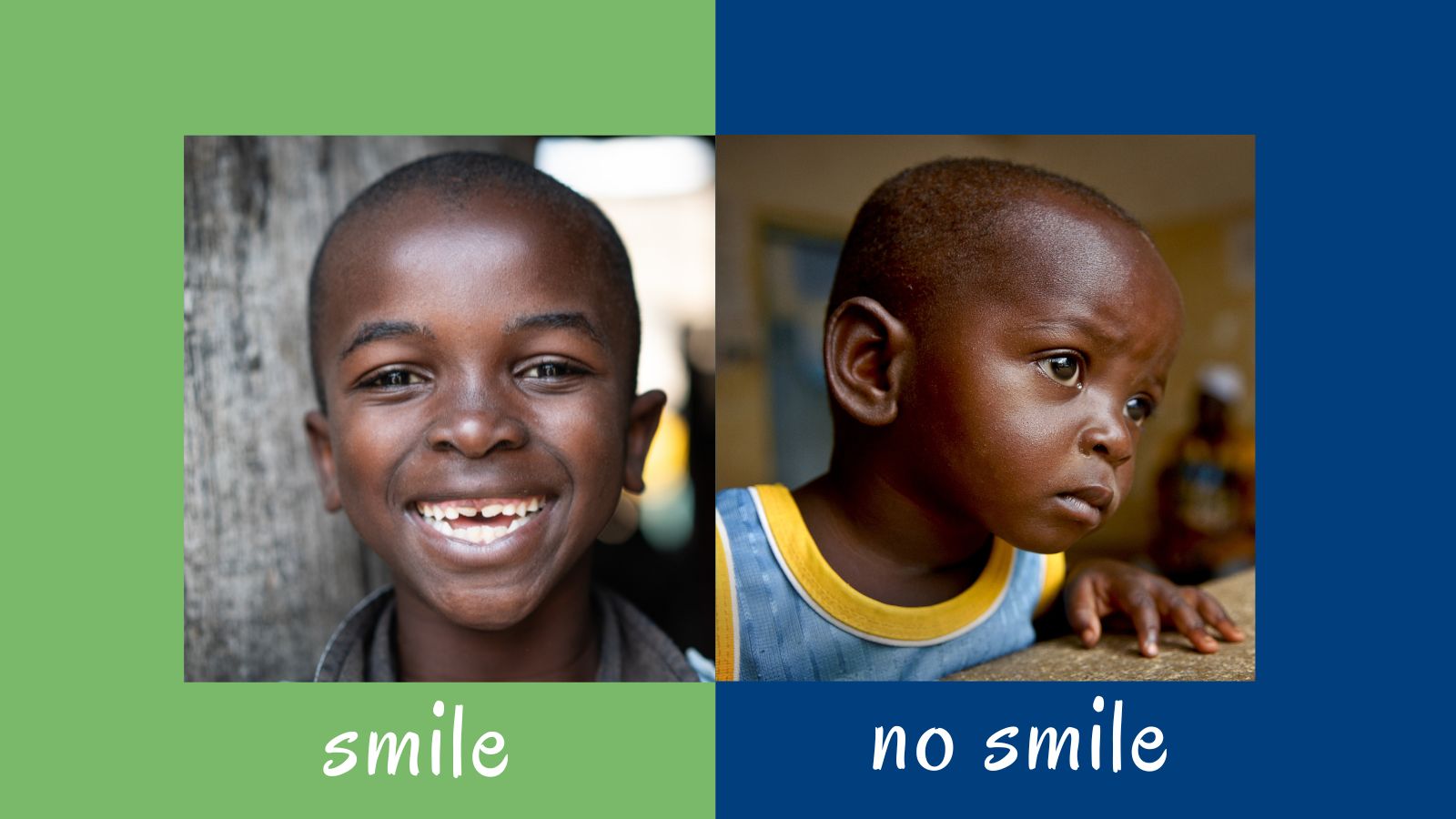
Happy or Sad: What Type of Images Will Help Your Nonprofit Raise More Funds?
Simple, straightforward question, not-so-simple answer. As people on Facebook like to say about their relationship status, “It’s complicated.”
A few things to keep in mind:
- There’s both art and science in selecting the right photos. And whether the subject is happy or sad isn’t always the most important variable to focus on. A photo that illustrates, complements, or enhances the package or email can ultimately be more important than whether the subject is smiling or not.
- Some photos are just more interesting or engaging than others. It isn’t unusual to look at 30 photos of the same subject and have one or a couple that captivate you more than the others. When you identify one like that, name it, and bookmark it for future use.
- Selecting photos for a fair, apples-to-apples test can be complicated. Unless you use a photo that’s exactly the same except for the subject’s expression, there are many other elements in a photograph than can muddy your conclusions. Furthermore, some appeals may function better with a sad photo more than a happy one. An appeal for help after a hurricane may perform better if your photo(s) depict the destruction rather than a relief truck distributing aid to victims. An appeal about microenterprise, on the other hand, might perform better if you show a farmer making use of the seeds and new tools he’s been given. There are countless scenarios and realities that can be depicted – not just in photos, but also in copy and offer – to influence how a donor mentally processes the need and the solution you’re offering. When you think about it, you quickly realize why a “happy vs. sad” approach is overly simplistic and why there seems to be a lot of conflicting advice on this topic.
So, in deciding what kind of photography to use, ask yourself these questions:
Who is your organization?
The first thing you need to figure out is what is the brand of your organization and how that will impact your choices in photography? You might have a powerful image, but for one reason or another, your executive director insists it should never see the light of day. As memorable as the image might be, it might give a false sense of the problem or the need your org meets, or might be perceived as exploitative in some way. Even if you think the image will help you raise funds in the short run, be careful. Fundraising techniques – whether tone of voice, presentation of offer, photo usage, etc. – shouldn’t be at odds with your nonprofit’s identity. Short-term gains (i.e., bringing in more dollars on one appeal) could change how the public views you and potentially turn off your most committed donors over time.
Beyond branding and public perception, photographing people at what might be their lowest point, and blasting those images to the public for money, can be exploitative and perpetuate biases around class, nationality, and race. Messaging that paints the donor as the only hope for people in need adds insult to injury. We’re all for donor-centric fundraising and encouraging donors to feel good about giving, but falling all over them with unwarranted praise seems disingenuous and out of touch with the prevailing winds in 2023 America.
Take the example of an international relief and development charity. You want to cast your donor as an integral part of the help equation. But if you put them on too high a pedestal, casting them into a “white savior” role, you run the risk of denigrating the people they’re meant to be helping and/or diminishing the role of local relief partners who are typically key to the nonprofit’s work. So let your donor know they’re critical to your good work, just be clear and graceful about giving some credit to and preserving the dignity of others involved, most importantly those who are receiving support.
Keep in mind, too, the power differential between, say, a poor mother or father and an organization providing them with emergency food for their family, clean drinking water, or other humanitarian support – maybe even a new house. The more urgent the need, the greater the inherent pressure the mother or father might feel to sign a photo release. Organizations should go the extra mile to respect their aid recipients’ dignity. We understand the dilemma – the desire to capture and use dramatic photos to raise more funds – but, in our view, that shouldn’t come at the price of a person’s or community’s dignity.
No easy answers. No one-size-fits-all solution. No “do this, don’t do that.” Sorry, but it’s an organization-by-organization, appeal-by-appeal, photo-by-photo discussion you should have with your creative – and in some cases with your executive – team.
To be clear, not every sad or distressing photo takes advantage of its subject. Some organizations in the animal welfare space, for example, use graphic images of abused and tortured animals to galvanize their donors and to raise funds. This approach works for some organizations, and is very much on brand for some, but even those may get better results with at least some donor segments who are put off by the images.
With that “different strokes for different folks” thinking in mind, let’s get back to our core examination of happy vs. sad.
 What does the research say?
Some recent studies suggest that the happy vs. sad question depends on what group of donors you’re talking about or the messaging that accompanies the photograph, or some other factor or combination of factors. Depending on who you ask or what you read, you’ll learn that:
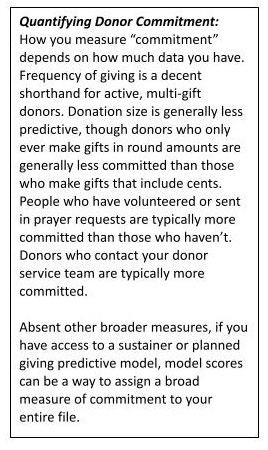
Happy images produce better giving from your most committed donors and that sad images produce better results from less committed donors: https://philanthropydaily.com/do-happy-faces-or-sad-faces-raise-more-money/
Or that a sad image with hopeful copy might produce the most likely donation response:
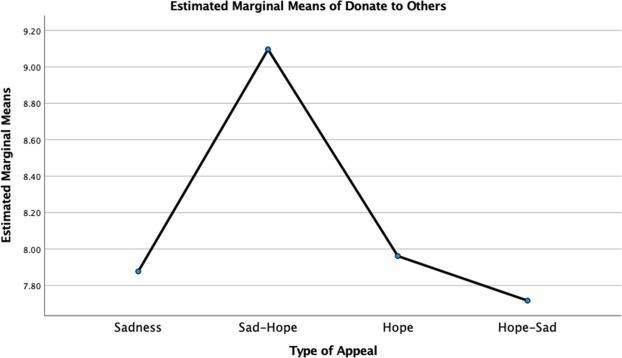 https://www.sciencedirect.com/science/article/pii/S0148296321003477
Or that eye contact could have a negative impact on giving with a sad image, but a positive impact with a happy image:
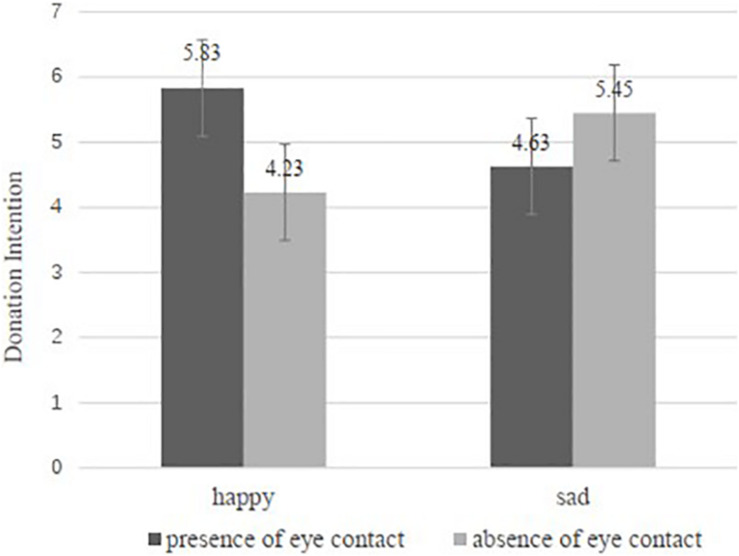 https://www.ncbi.nlm.nih.gov/pmc/articles/PMC8418068/
Or that prevention-oriented donors are more likely to respond favorably to happier appeal content:
Go back more than a decade and you can find research data to support almost any conclusion.
Beyond the often-conflicting data, there are also massive caveats around all the available test data. Fundraisers tend to view appeals in isolation, but the donor relationship with a nonprofit’s fundraising materials is much more complicated in real life. Frequent use of sad images heightens donor fatigue, even in those groups of donors who might typically be more responsive to sadder imagery. Conversely, a sad image could be more powerful when preceded by a series of happier images.
Never mind that donors are people, so assuming everyone reacts the same way, all the time to a particular image oversimplifies a very complex interaction. There is very little data available that incorporates individual personality types in the equation. Researchers sometimes note that subjects think that sad photos are attempts to manipulate them, but we’re not aware of any tests that have controlled for that or attempted to identify, say, how those individuals might score on the trust scale.
This is all very “heady” and interesting for the analytical types, but something of a mixed bag in terms of actionable data.
What’s the context?
Another factor to consider when deciding to use happy or sad imagery is the subject matter and aim of the fundraising or other communications piece.
Disaster appeals are a subset of fundraising appeals that very much necessitate the “focus on the need” strategy. Pictures of destruction and people in distress just come with the territory. With disaster response appeals, getting into the mail quickly trumps photo selection and other content decisions. That doesn’t mean photo selection is unimportant, but it’s not as critical as in less time-sensitive campaigns. Getting in front of donors before competing orgs do and before media attention moves on to other news are both far more important.
DRTV is broadcast to the masses, so the chances of reaching a committed, existing donor is unlikely. It’s primarily an acquisition tool and, as a result, speaks most directly to people who have never engaged with your organization. There are also fewer variables, such as prior, possibly contradictory messaging, to deal with. With the freedom to create with a blank slate, the most successful DRTV spots have highlighted dramatic, attention-grabbing, sad imagery. Think Sarah McLachlan, “In the arms of the angel…” The focus here is the problem, and the donor-to-be is the solution. No fuss, no muss, no competing interests.
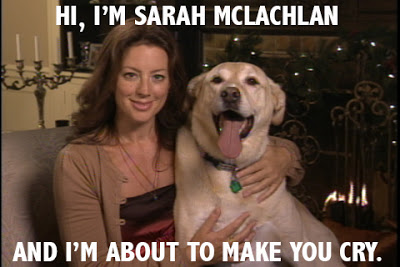
Newsletters are on the opposite end of the spectrum. Newsletters typically go to existing donors, who then self-select based on their commitment to an org whether they will read a little, or all of it, or toss it straight into the circular file. They are also not primarily for the purpose of raising funds; they are cultivation tools to make donors feel good about their prior giving and help promote future giving.
Imagery in newsletters should emphasize fulfillment and successes, and as such should favor happier photos to show donors that their generosity is making a difference. That doesn’t mean you should never use sad photos in a newsletter, just that when you do, you typically should pair it with a feel-good “after” shot as well.
Planned giving is about hope, long-term impact, and legacy; so sad faces are usually not your best foot forward.
Thank-you letters should also feature a happy image. For once in this often-murky discussion, you can consider that a hard and fast rule.
What is available to use?
In the real world, we are often at the mercy of the available assets – and that’s nowhere truer than with fundraising photography. Your dream, money photo might feature a solo, sympathetic subject in focus, looking straight into the camera, with an innocent demeanor, naturally posed, with no distractions in the foreground or background, and high enough resolution for quality reproduction. But most of the time that dream photo exists only in your mind – and you won’t be choosing between two great, but similar photos, one happy and one sad. In our long experience, getting great assets that match up with your creative vision – even among sophisticated and well-staffed nonprofits – is more miss than hit.
In the best-case scenario, you plan an appeal to execute in the future and you have photographers tasked with capturing the specific images you need. Even then, there is no guarantee that you’ll wind up with happy and sad images of the same subject and equal quality.
In a world of limited options, a sad vs. happy subject is only one among many variables you’ll have to consider. In fact, the best image for your appeal may not even come down to happy vs. sad, but about blurry vs. sharp, useable resolution or not, or some other basic criteria. And then, as you dream your campaign into being, you also have to decide your approach to copy: Is it straight doom and gloom? Doom and gloom with a side of light and hope? Vice versa? Or something else. So, in our mind, that shakes out to this:
Is happy or sad even the right question?
And the short answer is, probably not.
The answer may be more definitive in, say, social media, where the primary message is the image. Even here, though, there is evidence that a mixed message – a combination of happy image and sad copy – produced the best response.


https://business.okstate.edu/behlab/assets/septianto_paramita_2021.pdf
For all the effort to clearly define the happy or sad conundrum, we’re convinced there isn’t really a definitive, absolute solution. But that doesn’t mean your time ruminating with us on the “happy vs. sad” question has been in vain – we can leave you with some news you can use:
These questions will help you make the best decision when choosing photos for your nonprofit’s fundraising and communications efforts –
Do the photos you’re considering:
- support and align with your organization and brand?
- exploit or compromise the dignity of the people you are trying to help?
- contribute to and reinforce the story you’re attempting to tell?
- work technically (resolution, etc.) and aesthetically (composition, contrast, etc.?)
- contribute to your fulfillment and legacy communications efforts?
- accurately convey needs and/or the work you seek support for?
- avoid being so unbearably sad as to fatigue your most loyal donors?
- work with your copy and design to present both problem and solution in a compelling way?
Recognizing that a picture is worth 1,000 words – and that it can convey multiple if not 1,000 meanings – think hard about the images you consider and choose for your fundraising efforts.